Free on-demand webinar: Building belonging: a nonprofit's guide to accessibility best practices

.svg)
.svg)
.svg)
.svg)
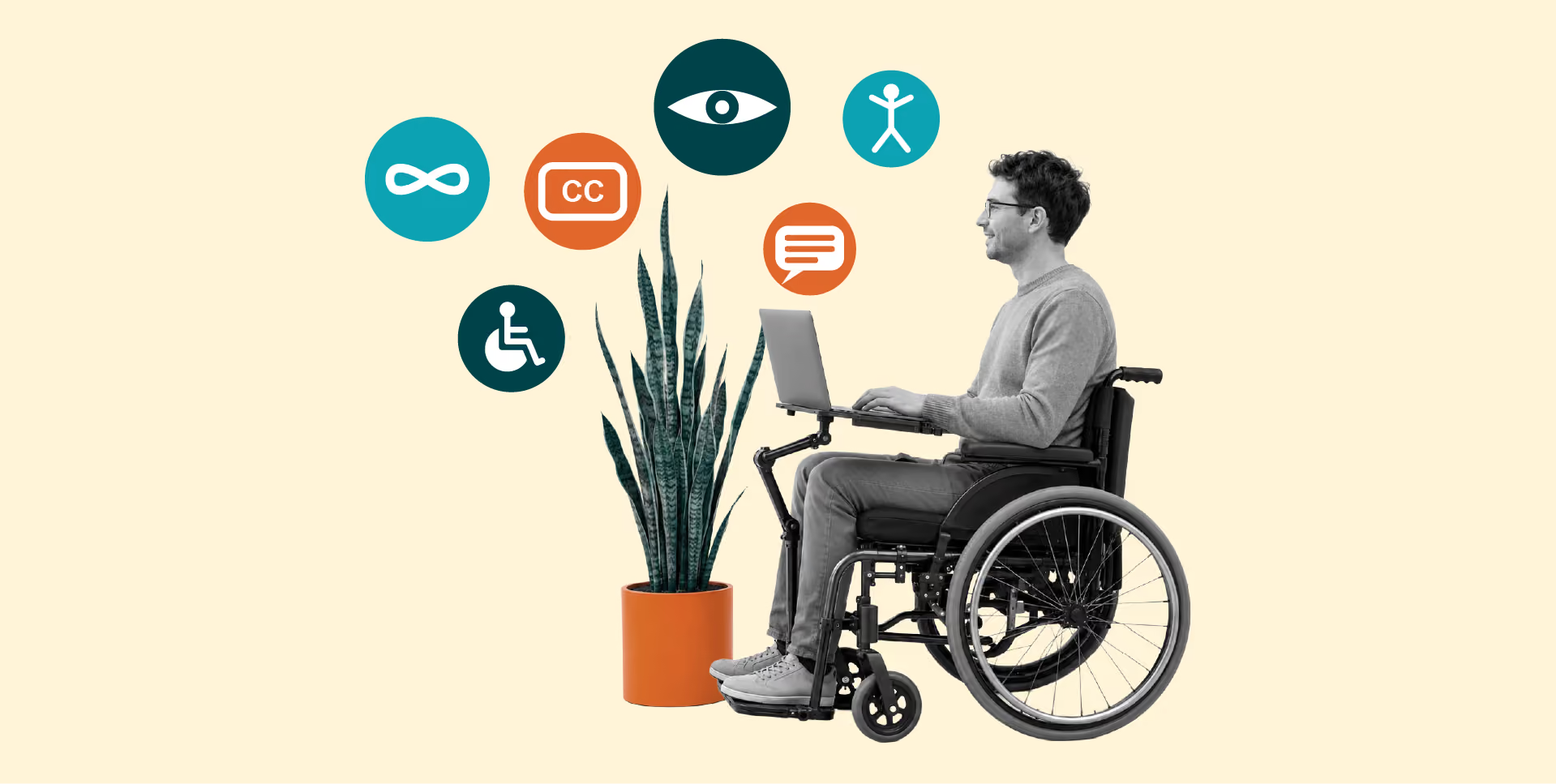
Accessibility has been a baseline civil rights requirement since the passage of the Americans with Disabilities Act. However, accessibility is also one of the most overlooked standards in nonprofit fundraising, even though nonprofits with accessible events, websites and communications reach more donors, serve more communities and reduce legal risk.
On August 27, 2026, Give Lively hosted a free webinar built around that idea: Building Belonging: A Nonprofit's Guide to Accessibility Best Practices.
Disability rights and accessibility consultant Robin Troutman and Prevention of Blindness Society of Metropolitan Washington's Nick Farano joined Give Lively for a practical session on building accessibility into nonprofit events, digital properties and culture. Give Lively’s lead product designer, Olivia Gulin, also weighed in on what putting accessibility practices into action looks like.
View our free accessibility webinar on demand
Building Belonging: A Nonprofit's Guide to Accessibility Best Practices
Cost: Free
Who it’s for: This webinar is built for nonprofit staff who touch any part of the donor or constituent experience: nonprofit development, marketing and communications teams; event staff planning in-person or hybrid programming; and program staff thinking about how the organization shows up for disabled community members. No technical background needed; the session is built around practical, actionable guidance, not code-level detail.
Added benefit: Free access top a downloadable guide to accessibility for nonprofits.
What the session covers
External best practices, with Robin Troutman
Robin began by contextualizing the scale of the U.S. disability landscape and the value of folding accessibility practices into everything a nonprofit does.
She then walked through where accessibility matters most for a nonprofit: physical venues, digital ecosystems and organizational culture.
In-person events
Robin reviewed venue selection, seating, staging and travel logistics well before the event itself. This includes a practical event accessibility checklist of everything from designating a point person for accommodation requests to reserving funds for captioning or American Sign Language interpreting.
Digital properties
Robin tackled web accessibility standards (WCAG 2.1 Level AA) and the four guiding principles: perceivable, operable, understandable and robust. She addressed mobile app accessibility, such as touch target sizing and support for native screen readers, and what to look for in a virtual event platform, from live captioning to a reliable dial-in option for attendees.
She also mentioned how the legal landscape is tightening. Recent Department of Justice Title II updates set firm 2027 and 2028 compliance deadlines for state and local government websites and apps. Private nonprofits aren't on the same timeline, but some already face lawsuits over inaccessible websites and donation pages. Building accessible digital properties now protects an organization from exposure instead of responding to it after a complaint.
Accessible culture
Robin focused on dignified engagement: treating assistive devices as an extension of a person's physical space, training staff in respectful language and offering help without assuming what someone needs.
Curb-cut effect
Robin closed her presentation with the curb-cut effect: the idea that features built for accessibility end up benefiting a much wider audience. Curb cuts were originally installed for wheelchair users, but parents pushing strollers, delivery workers and anyone dragging a suitcase use them too. The same pattern shows up online. Accessible design rarely serves a narrow group; it raises the experience for everyone.
Inside Give Lively, with Olivia Gulin
Olivia Gulin, Give Lively's lead product designer, gave a candid and inside look at the platform's own accessibility work targeting WCAG 2.2 AA standards.
Olivia walked through what's working, such as a cross-functional Accessibility Special Interest Group, accessibility audits using third-party tools and a "shift left" approach that builds accessibility into product requirements and design systems from the start.
She reviewed how frontend components are tested with automated tooling, how the product team includes disability-focused member nonprofits in testing and research and how the marketing team works toward a website that functions for all.
A nonprofit perspective, with Nick Farano
Nick, Vice President of Operations and Development at Prevention of Blindness Society of Metropolitan Washington, pulled from lived experience with his organization to talk about how accessibility has made a difference, the challenges involved and why other nonprofits should give it their attention.
Live Q&A
The session closed with audience Q&A, giving attendees a chance to bring their own accessibility questions directly to Robin, Nick and Olivia.
Why accessibility deserves its own conversation
U.S. Census Bureau data from 2021 illustrates the scale of the need. There are approximately 42.5 million Americans with disabilities, equal to 13% of the civilian population. This includes people with hearing, vision, cognitive, walking, self-care or independent living difficulties.
Despite this, many nonprofits treat accessibility as a compliance checkbox, something to address after a website or event is already built. That framing misses the point. Inaccessible systems create friction for people with disabilities at every turn, from registering for an event to navigating a donation page. Widely available accessible technology and practices are two vital levers that can help.
This webinar elevates accessibility, recognizing it as a civil right and a fundraising opportunity, not an afterthought bolted onto an existing program.
Benefiting everyone
Every barrier that donors or constituents hit before they can act in support of a nonprofit's mission narrows the organization's reach. A donation form a screen reader can't parse, a webinar with no captions, an event venue without accessible seating: each one quietly excludes people without meaning to.
Building accessibility into standard practice, rather than retrofitting it after a complaint or a missed opportunity, is both the right thing to do and a way to reach new donors, especially at a time when new donor acquisition and donor stewardship are increasingly important. As this webinar emphasizes, designing for accessibility benefits everyone.
%201.svg)