


Growing a giving community: using Peer-to-Peer Fundraising to reach new donors
A small development team is expanding its individual giving program one peer-to-peer campaign at a time.
About this member
- Partners with individuals, families and communities to create environments that support long-term health and wellness
- Member since February 2024
- 606 donors as of June 2026
- $60,000+ as of June 2026
Products they use:


The product-page images shared here are for reference and inspiration only and may not reflect current designs. Interfaces may change as donor experience improvements are made and accessibility is boosted. Some nonprofits may also make custom changes beyond our control.
Mental Health Connecticut (MHC) has been showing up for people across the state for more than a century. Founded in 1908, the organization provides housing, food access, employment programs, mental health care and more to over 1,000 individuals every day. Its vision is a future where well-being is rooted in respect for the condition of being human.
For a mission this expansive, sustainable funding matters. Like many nonprofits, MHC has relied primarily on government contracts, but its small and dedicated two-person development team has been working to diversify revenue through individual giving, corporate partnerships, foundation grants, sponsorships and planned giving. Give Lively became part of that strategy when MHC became a member in February 2024.
"Give Lively provided greater flexibility, top tier customer service, a more modern interface and tools that better supported our fundraising goals while reducing costs," says Bethany Simmonds, Senior Director of Advancement. "It allows us to focus more resources on our mission rather than fundraising infrastructure."
Peer-to-peer fundraising as a donor acquisition engine
When a nonprofit is actively building its individual giving program, one of the most meaningful questions is: how do you reach people who have never heard of you?
For Mental Health Connecticut, peer-to-peer fundraising has become a core part of the answer. Rather than relying solely on its existing network, MHC uses Give Lively's Peer-to-Peer Fundraising product to activate board members, volunteers and supporters as ambassadors who invite their own communities to learn about and give to the cause.
The results have been tangible. Some of MHC's most valuable new donor relationships have come directly through peer-to-peer campaigns, where a supporter's personal connection to the mission does the work of introducing the organization to an entirely new audience.
Simmonds's advice to other nonprofits is direct: "Fully embrace peer-to-peer fundraising from the start. Many organizations focus primarily on direct donations, but peer-to-peer campaigns can be incredibly effective for expanding your reach and introducing your mission to entirely new audiences."
She also recommends giving peer-to-peer fundraisers a reason to participate. "Consider offering incentives, recognition or friendly competition to encourage participation and make fundraising more engaging for supporters."
The inaugural "Tails of Wellbeing" virtual 5K
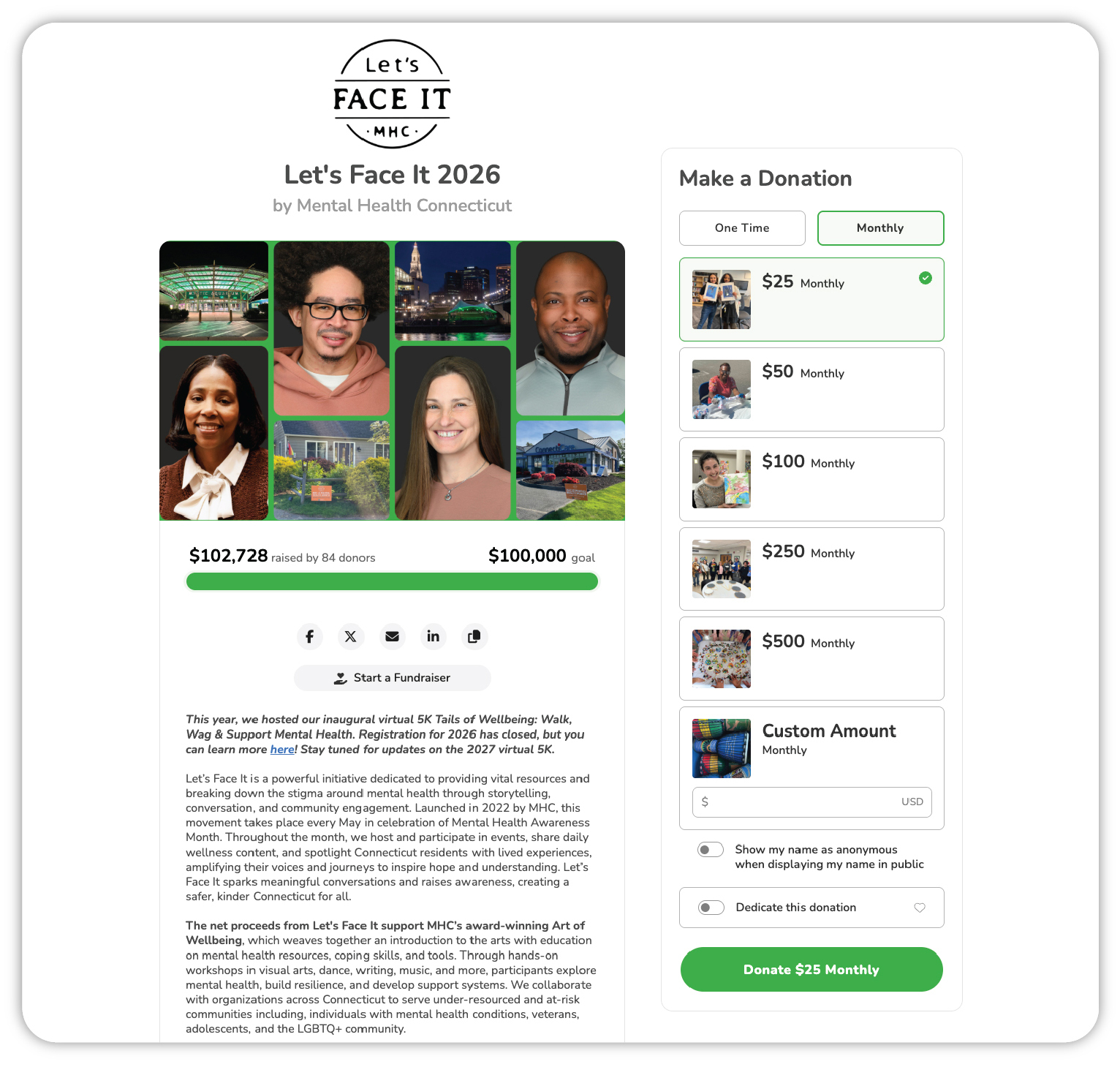
In 2026, as part of its “Let’s Face It 2026” campaign, Mental Health Connecticut launched its first-ever virtual 5K – Tails of Wellbeing: Walk, Wag and Support Mental Health. The campaign is anchored in a Give Lively Campaign Pages but powered in large part by peer-to-peer fundraisers, with 11 leaders rallying their networks around a shared goal.
The campaign surpassed its $100,000 goal, through both online and offline donations.
The virtual 5K format was a very deliberate choice. "One of our favorite creative uses of the platform was adapting a campaign page to host a virtual 5K fundraiser," says Simmonds. "The flexibility of Give Lively allowed us to create an engaging online experience, encourage participation from supporters across different locations and raise funds without the logistical complexity of an in-person event."
Event Ticketing, Donation Widgets and custom questions
Beyond peer-to-peer campaigns, MHC uses Give Lively across its year-round fundraising calendar. Donation Widgets embedded directly on the MHC website allow supporters to give without leaving the page. Campaign Pages support seasonal appeals, including Mental Health Awareness Month and year-end giving.
In anticipation of a winter 2026 wine tasting fundraiser, MHC used Give Lively's Event Ticketing product for the first time. The experience, Simmonds notes, was seamless for both staff and attendees.
MHC also takes advantage of custom questions on its donation forms, using them to gather information that guides stewardship and helps the team better understand what motivates supporters to give.
Removing barriers so the mission can move forward
Simmonds is thoughtful about how she characterizes Give Lively's role in MHC's growth. Fundraising success, she notes, comes from many factors: strategic planning, donor outreach, stewardship. The Give Lively platform eliminates the friction that can stand between a good strategy and its execution.
For a small development team, the ease of getting started mattered as much as the features themselves. "One pleasant surprise was how quickly we were able to launch campaigns and customize donation pages without requiring significant technical expertise," says Simmonds. "The platform strikes a great balance between functionality and simplicity, which is especially valuable for small development teams like ours."
That simplicity compounds over time. "What Give Lively has done exceptionally well is remove barriers," she adds. "The platform makes it easy for donors to give, easy for staff to launch campaigns, and easy for supporters to create peer-to-peer fundraisers on our behalf."
For a two-person development team supporting an organization that serves more than 1,000 people a day, that kind of efficiency isn't a small thing. It's what makes room for the mission.


