Corporate donations and matching gifts: how to unlock business giving

.svg)
.svg)
.svg)
.svg)

For many nonprofits, corporate giving is treated as a secondary priority, something to pursue after annual fundraising targets have been met or when an event needs a presenting sponsor. Yet corporate donations to nonprofits have grown steadily, and companies today often offer far more than grant applications or event sponsorships. Treating corporate channels as an afterthought means leaving revenue untapped.
This is a guide to identifying the right contacts, understanding how matching programs work and building a sponsorship structure for nonprofits aiming to increase funding with corporate donations.
Why corporate giving deserves a dedicated strategy
According to Giving USA, corporate giving reached $44.4 billion in 2024, a record high in both current and inflation-adjusted dollars. It’s also an increase of more than 50% since 2019.
Much of it can be attributed to a broader range of program types. Beyond direct grants, corporations that donate to nonprofits may provide matching gift programs, volunteer grants, in-kind contributions and event sponsorships.
Each channel operates on its own terms and with its own contacts, creating distinct value for both benefactor and beneficiary. This being said, most nonprofit organizations give real attention to only one or two channels, leaving the rest, like corporate matching, largely untapped.
6 ways to build a stronger corporate giving strategy
1. Identify decision-makers before reaching out
One common mistake in corporate outreach is to treat each company as a monolithic entity with only one decision-maker. In practice, there are many key points of contact and the right one depends on what’s being asked.
- Cash contributions and corporate grants typically route through a community relations department, corporate social responsibility (CSR) department, public affairs department or a separate corporate foundation.
- Sponsorships are usually handled by a marketing team and call for a pitch centered on brand visibility and audience reach.
- In-kind donations often come from local managers or store-level contacts rather than headquarters.
- The human resources (HR) department, meanwhile, almost always manages employee-driven programs like matching gifts and volunteer time off.
When a grant proposal lands with a community relations team that has no visibility into HR-managed matching programs or when a cash sponsorship request reaches an HR contact, friction follows on both sides. A little upfront research into who manages what makes outreach more targeted from the outset.
2. Mine the existing donor base for corporate prospects
The pool of corporate prospects most readily at hand is the one nonprofits already have: their existing supporters.
Donors who work for companies with active giving programs represent a natural starting point, since existing individual relationships can be springboards for corporate connection.
Donation forms that include a matching gift employer search tool allow donors to immediately determine their match eligibility. It also builds a picture of which companies employ a nonprofit’s supporters – useful intelligence for corporate outreach down the line.
Over time, the data establishes a workable prospect list, all through routine donation processing rather than research. Building match visibility into the standard donation experience generates this prospect intelligence as an actionable byproduct.
3. Understand how matching gift programs are structured
Matching gift program structures vary considerably and each company’s setup affects what a partnership can deliver.
According to Double the Donation data, 91% of companies match employee donations at a 1:1 ratio, with around 5% offering higher rates such as 2:1 or 3:1.
Programs also frequently set a minimum match requirement (averaging around $34) and an annual maximum per employee (commonly $500 to $10,000).
The ceiling is worth knowing in advance. A company with a $1,000 annual cap will yield different results from one with an upper limit of $10,000, even at identical gift ratios.
Plus, rather than speaking with donors in vague terms about "doubling" their gifts, nonprofits can share precise information about how much an employer will contribute. This kind of specificity can help boost donor confidence too.
4. Develop a sponsorship structure before contacting companies
When a nonprofit approaches a company with an open-ended sponsorship request, the burden of program design falls to the funder. Instead, a tiered structure proposed by the nonprofit gives companies a menu to work from.
A basic sponsorship menu sets clear participation levels covering event naming rights, logo placement in communications and recognition across social media and program materials, among other things. Tiers also open the door for smaller local businesses that might decline a single large solicitation but can participate at a lower level.
Sponsorships usually involve financial support in exchange for agreed visibility, a two-way dynamic quite different from a one-way philanthropic grant. Keeping that distinction clear in outreach and documentation helps manage expectations on both sides.
5. Weave match visibility into every donor touchpoint
Unfortunately, a significant number of donors who work for companies with matching gift programs either don’t know the programs exist or don’t realize their gift qualifies. The gap is primarily one of communication, which nonprofits can address directly.
Research from America’s Charities found that 1 in 3 employees say they would give a larger gift if their donation were matched. This suggests that matching messaging lands best when it appears early in the giving experience rather than only in follow-up communications. Donation forms, confirmation emails, acknowledgment letters and year-end appeals are all natural places to prompt donors to check their match eligibility.
Importantly, many companies allow employees to submit match requests six to 12 months later, or through the end of the calendar year. Depending on when match-eligible donations come in, a targeted midyear reminder and year-end prompt can recover revenue that would otherwise go unclaimed.
For practical tips about a structured approach to corporate giving during the summer lull, watch this free on-demand webinar, "The Summer Fundraising Playbook: Maintaining Momentum and Unlocking the Power of Matching Gifts."
6. Prioritize alignment over name recognition
Fortune 500 companies dominate conversations about corporations that donate to nonprofits, but they’re rarely a practical starting point for nonprofits building a corporate fundraising strategy.
Because large companies attract more attention, they tend to have competitive application processes with longer grant cycles. Smaller regional and local businesses, by contrast, are often more accessible and more invested in the kind of visible, localized business partnership that a national program might not prioritize.
Regardless of company size, those whose stated CSR priorities align with a nonprofit’s mission are stronger candidates than those approached on the basis of brand alone. Researching a company’s recent giving history and community focus areas before reaching out usually improves outcomes.
Build a fundraising foundation with Give Lively
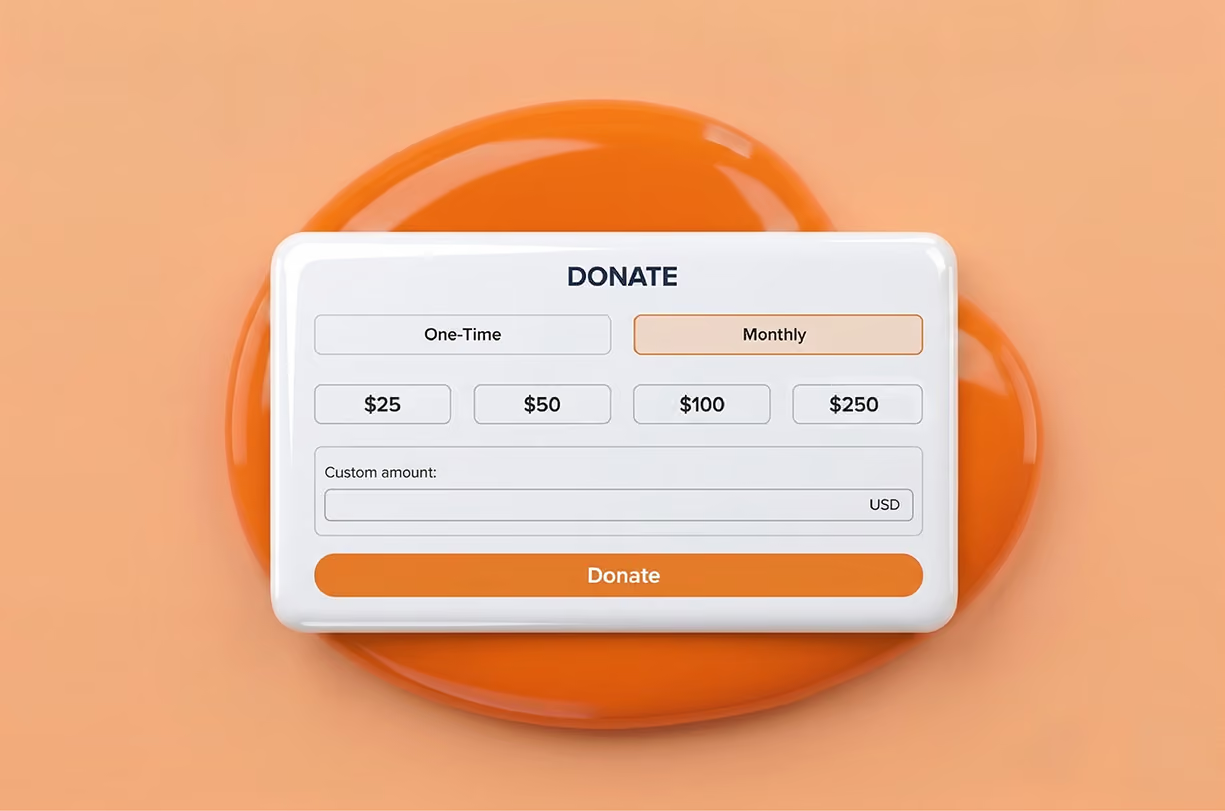
A corporate giving strategy is easier to construct with fundraising infrastructure already in place. Give Lively’s free platform integrates integrates directly with Double the Donation, automatically surfacing match-eligible donors during the donation process by adding prompts to donation forms and capturing readily available revenue in real time.
Learn more about Give Lively’s nonprofit fundraising software today or get a demo.
%201.svg)