How to stop things from going wrong at fundraising events for nonprofits

.svg)
.svg)
.svg)
.svg)

Event-planning guides usually outline what to do: Build a timeline, book a venue, send out invitations. That advice isn't wrong. However, in our experience, disappointing fundraising events for nonprofit organizations are rarely because of skipped best practices; they falter because no one caught an easily avoidable mistake.
The event organizers were tripped up by what they didn’t know NOT to do.
That's why we built a free nonprofit fundraising event guide around a different premise: "What a nonprofit should NOT do.”
Guide to creating an amazing fundraising events for nonprofits
Our guide is like a pre-mortem. Before an event production team is deep in logistics, it should walk through common event pitfalls and honestly assess whether any of them could be real. If even one rings a bell, it’s something to know to get ahead of.
The guide is structured to take into account seven major considerations for fundraising events for nonprofit organizations: design, accessibility and sustainability, marketing, management, run of show, strategic pivots and post-event priorities. Here’s a look at some of what it covers.

Event design: first decisions matter more than most people realize
Event design is where structure is set… and structural errors happen. The missteps are easy to overlook because everything appears fine in principle and on paper.
One common foundational faux pas is mismatching event format, audience and goal:
- A springtime outdoor BBQ might be a genuinely fun idea, but if a significant portion of the donor base has mobility challenges, the designed experience isn’t necessarily the one they'll have.
- Similarly, a classical music program might feel sophisticated – unless the event is meant to energize college-age voters.
These are hypothetical examples, but they’re typical of patterns seen again and again.
The fix isn't complicated: Better fundraising event ideas for nonprofits start with alignment. An event's primary objective and target audience should be posted prominently at every planning meeting. If a proposed element doesn't serve both, it should probably be abandoned.
Other design-stage traps include
- not planning for people who can't be there in person (livestreaming and recorded keynotes are easy to dismiss but worth the effort to set up)
- skipping contingency planning for weather, vendor cancellations or audiovisual failures
- failing to confirm a venue's technology can actually handle what’s needed.
To that last point, “great wifi" means different things in a hotel ballroom and in a conference room for 20. It needs to be tested in the actual space, before anything is signed.
Event accessibility and sustainability: not incidental
Accessibility and sustainability often get treated as additions to an event-management checklist, only addressed once the "real" planning is done. They shouldn't be and the guide elevates their importance. Attention to what they mean – and why to be public about them – translates into real positive perception.
Make everyone feel welcome
Accessibility means more than an entrance ramp and space for wheelchairs. It's confirming that pathways are genuinely barrier-free and assistive devices can be accommodated.
It’s educating speakers about how to present inclusively – describing presentation visuals verbally, using readable font sizes, practicing good microphone discipline.
It includes creating a code of conduct and proactively leaning into it before the event, in addition to posting it at the door.
More than just feeling good
Ecological sensitivity is increasingly what donors, younger attendees and community partners expect – local catering, minimized reliance on printed materials and transparency in the form of a post-event sustainability summary. Sustainability signals organizational values.
Event marketing: bookend work
Event marketing should be a core part of the event itself, but one all-too-common budget mistake is to treat event promotion as a line item to be trimmed when costs run over. Remember: a single save-the-date email rarely moves the needle and a beautifully designed event with low turnout is still a disappointment.
The guide makes the case for a multi-touch marketing sequence built over weeks, using email, social, paid digital channels, community partners and, yes, good old-fashioned print and shoe leather for community-rooted events. It covers how to give board members and peer fundraisers the tools to amplify the messaging, not just reshare it.
The other bookend – post-event follow-up – gets even more emphasis. Too many organizations go quiet at exactly this moment.
Event management: the unglamorous middle
Most event disasters have a paper trail: a venue contract no one read carefully, an alcohol license no one confirmed, a raffle that turned out to be restricted by local gaming laws, food that ran out 45 minutes in. These are the small things that can quietly make or break everything.
The event management section of the guide bullets the legal, logistical and staffing risks that experienced planners take seriously but first-timers often don't know to check. This includes how to empower volunteers (a step beyond simple recruitment), how to sequence catering so guests aren't hungry during the “ask" and how to do a technical dry run that actually reveals problems.
One detail that surprises organizations every year: mobile fundraising technology needs to be tested before the event from multiple corners of the venue and on multiple cell carriers. A text code that works at the check-in table may not work at the back of the room. That might sound like a minor inconvenience, but could be a direct hit to fundraising.
The moment itself: run of show
“Run of show” is the minute-by-minute choreography of an event. This section of the guide looks at key friction points – the small frustrations that dampen enthusiasm at exactly the moment it needs to be highest.
A slow check-in experience sets the wrong tone before the program even begins. A welcome speech that opens with logistics instead of a compelling personal story loses the room in the first two minutes. A buried or mumbled donation “ask” leaves money on the table.
The guide offers specifics:
- Structure check-in so it doesn't bottleneck.
- Build in programmatic "giving moments" and make them land.
- Ensure every speaker hits the same core message, even if delivery varies.
And it's clear about one thing that planning documents often leave out: joy! It is part of why people give. Leave room for it.
Four things worth replacing entirely
One distinctive section of the guide focuses on strategic pivots – practices that have become standard at fundraising events for nonprofits, but deserve a rethink. For fundraising event ideas for nonprofits that outperform the standard playbook, this section delivers.
For example, traditional auctions, pledge cards and passive board members all have better alternatives. The replacements in the guide are more fun for guests, less labor-intensive for staff and consistently produce stronger fundraising results. Events shouldn’t be left to run on autopilot.
Post-event priorities: the 72 hours after
The event isn't over when the lights come up. The guide is direct about this: the 72 hours after fundraising events for nonprofits are when donor retention, sponsor renewal and major-gift relationships are won or lost.
That means thank-you emails sent within 48 hours – segmented by audience (donor, attendee, sponsor, volunteer, the people who couldn't come but gave anyway), leading with impact rather than the tax receipt.
It means getting photos and a short recap video out on social media, maybe even before the last guests have left.
It means mobilizing board members to write personal notes, debriefing the team within two weeks and sending a short attendee survey while the event is still fresh.
The guide also covers reconciling offline gifts – cash, checks, pledges – so the final fundraising total tells the full story.
A note on how the guide is packaged
The full guide includes:
- a section-by-section breakdown of every "don't”
- a printable checklist designed for easy walkthrough 14 days before an event
- a curated resource library for topics like livestreaming, virtual fundraising events, internet testing and digital/mobile fundraising setup.
We built it this way because the organizations we work with deserve more than a generic playbook. Every fundraising event for nonprofit organizations has unique stakes. Nonprofits are doing important work and their events should reflect that – both in the mission they're raising money for and in the experience they create for everyone at an event.
The checklist alone is worth pondering, but the whole guide is packed with fundraising event ideas for nonprofits.
How Give Lively can help
Of course, executing a seamless, high-impact fundraising event for nonprofits ultimately depends on leveraging the right technology. Give Lively is built precisely for this, consolidating ticketing, text-based giving and live tracking into one intuitive platform. Importantly, Give Lively’s powerful, practical event fundraising features are free for member nonprofits – no platform fees, subscription costs or hidden charges.
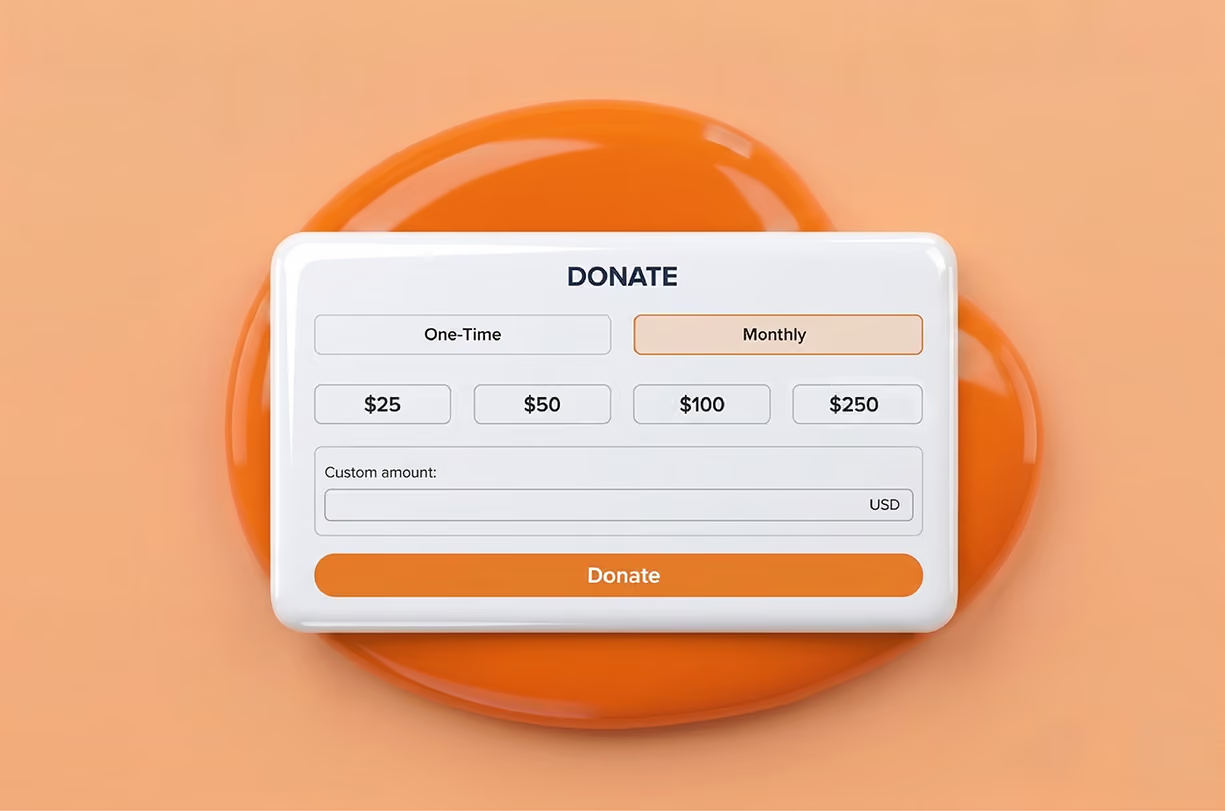
Nonprofits can create user-friendly Event Ticketing pages with custom payment tiers to streamline registrations and manage attendees. When it’s time for the live program, the mobile-first Text-to-Donate product removes giving friction for donors on the go. Paired with a real-time Live Display fundraising thermometer, it capitalizes on collective room energy and social proof to drive deeper donor generosity.
With Give Lively, nonprofit teams are free to focus entirely on guests, celebrate their mission and confidently build long-term donor relationships.
%201.svg)