You've started a nonprofit - here's what to do next

.svg)
.svg)
.svg)
.svg)

A favorable IRS determination letter is a genuine milestone for a nonprofit. It confirms that the organization is legally recognized, tax-exempt and ready to receive donations. After months of paperwork, that matters a lot.
But the determination letter, also called a 501(c)(3) letter or exemption letter, is a point of departure, not a destination. The real work of building a sustainable nonprofit begins the moment the letter arrives.
What to do after you’ve started a nonprofit
Leaders of new nonprofits sometimes imagine the post-formation period will be straightforward: get approved, kick off fundraising and grow.
In practice, however, there are several layers of compliance, infrastructure and relationship-building that come before meaningful fundraising is possible; skipping them runs the risk of creating problems later.
To put a nonprofit in the best position for success, follow the four steps below.
Step 1 – Handle your remaining compliance obligations
An IRS 501(c)(3) status letter resolves the federal side of the compliance picture, but it leaves the state side and annual returns unaddressed. New nonprofits must complete at least two additional compliance tasks before they can legally fundraise, and both require ongoing renewal.
Register with states to fundraise
IRS 501(c)(3) recognition grants federal tax-exempt status, but it doesn't automatically authorize fundraising in every locality in the United States. Forty states presently require nonprofits to complete a Charitable Solicitation Registration (CSR) before soliciting donations from their residents. Importantly, the term "soliciting" extends to digital channels: email appeals, online fundraising and social media campaign posts all count.
Organizations running fundraising through unrestricted digital channels or multi-state campaigns face registration requirements in all or each state, as well as annual renewals. The National Association of State Charity Officials maintains a directory of state charity oversight offices and is a practical first stop for understanding where filings are needed.
Know your Form 990 obligations
Every U.S.-registered 501(c)(3) organization files an annual return with the IRS, and the form filed depends on gross receipts. Nonprofits bringing in under $50,000 use the 990-N, a streamlined electronic “postcard.” The 990-EZ covers gross receipts between $50,000 and $200,000, while larger entities file the full Form 990. The submission deadline falls five months and 15 days after the close of the fiscal year, so for a calendar-year organization, the due date is May 15.
Missing three consecutive years of filings results in automatic revocation of tax-exempt status. A compliance calendar that tracks Form 990 deadlines, CSR renewals and any required state annual reports stops an organization from falling behind before it's had a chance to get ahead.
Step 2 – Build your financial foundation
Sound financial infrastructure doesn't require a large budget or an accounting team. It requires separation, structure and documentation, ideally right from the outset. Organizations that develop healthy habits early find compliance, grant reporting and board oversight easier as they grow.
Two essential ways to establish a strong financial foundation are a dedicated bank account and an accounting system.
Open a dedicated nonprofit bank account
A bank account specifically for the nonprofit separates organizational funds from personal finances, a basic distinction with real consequences for liability, transparency and donor trust.
Financial institutions generally require standard documents to open a nonprofit bank account, such as the organization's EIN, articles of incorporation, adopted bylaws and a board resolution authorizing the account. Opening a bank account early simplifies everything that follows, from recording donations to preparing the annual Form 990.
Implement a budget and accounting system
Budget ratification is a vital and practical primary task for leaders of new nonprofits. A first operating budget weighs projected revenue against anticipated expenses. Revenue sources typically include individual donations, grants, events and service fees charged for programs (earned income). These should be distinguished from costs, especially administrative overhead, right from the beginning.
Keep in mind that grant applications and IRS forms both ask how incoming funds are allocated. Organizations that blur any lines can run into reporting complications down the road.
For accounting systems, the choice between outsourced nonprofit accounting and in-house management depends on organizational capacity. Either way, internal controls matter.
Even rudimentary policies around who authorizes expenditures and who reviews financial records go a long way toward preventing mismanagement. Good records from day one also make Form 990 preparation and grant audits considerably less stressful.
Step 3 – Build your board with intention
Assembling a board of directors is one of the most consequential actions for a young nonprofit, and one of the most commonly underestimated. Who sits on the board, what skills they bring and how clearly their roles are defined impact everything from fundraising capacity to organizational credibility. Getting board composition right from the start is easier than course-correcting later.
Here are some top tips for assembling a board as a new nonprofit.
Move beyond the friends-and-family board
Nearly every nonprofit launches with what practitioners call a "friends and family board,” which usually contains people who care about the mission and said yes when asked. There's nothing wrong with that, but it’s not an ideal solution for the long term.
Early-stage nonprofits need a working board, meaning a board with members who make hands-on contributions to fundraising, programming and organizational development. An engaged board is a genuine resource.
However, when board members consistently miss meetings, disengage from the work and/or contribute nothing to fundraising, the organization ends up carrying itself, draining the founder's capacity. Since friends-and-family boards aren’t typically staffed by experts, it’s best to move away from them as soon as reasonably possible.
Recruit for skills and onboard with structure
Common gaps in founding nonprofit boards are people with financial, legal, marketing and fundraising experience or, even better, expertise. Existing donors and volunteers are often overlooked sources of board candidates, as they’re already invested in the mission and may be willing to serve more formally. Referrals from current board members can further expand the pool.
Once recruited, board members need structure to be effective. An orientation packet gives new members context, covering the current budget, committees list, meeting calendar and contact information.
Clear expectations around attendance, financial contributions and fundraising involvement – ideally discussed before someone joins – prevent the disengagement that comes from ambiguity.
Step 4 – Set up your online presence and donation infrastructure
A nonprofit's digital presence does two things at once. For people who haven't encountered the organization before, it serves as an introduction. For donors, volunteers and partners who already know the work, it provides a place to engage and give.
Both functions depend on having the right infrastructure in place. A website with no donation capability, or a donation flow that creates friction, limits what an organization can accomplish online, regardless of how strong the mission is.
Here’s some advice about how to set up an online presence and donation infrastructure.
Launch your website and social presence
A website is the anchor for everything else a nonprofit does online. At minimum, an organization's site communicates the mission clearly, identifies leadership, includes contact information and offers a way to donate. Those four elements give visitors what they need to understand, trust and support the work.
After an organization publishes a website, it should decide what social media platform(s) to focus on. This depends on where the target audience congregates. For instance, Facebook has integrated community-building tools and fundraising features, making it useful for broad donor engagement. Instagram is well-suited to visual storytelling and nonprofit beneficiary spotlights. For professional networking and corporate partnerships, LinkedIn is worth the investment.
One or two platforms is best at the start, since posting consistently on selected channels outperforms spreading thin across all of them.
Use a digital fundraising platform built for nonprofits
A common question for new nonprofits is how to begin accepting digital donations. Many leaders initially gravitate toward familiar consumer tools like Venmo. These are not the best options. Consumer payment platforms work for personal transactions, but present real gaps for organizations.
For example, the IRS requires written acknowledgment of gifts over $250, but consumer platforms often don’t provide automatic tax receipts. Similarly, nonprofits may need financial reports for board meetings and wish to track donor history. These platforms offer only limited reporting and may lack a way to export donor data.
That’s where dedicated nonprofit fundraising platforms step in. They can handle all of those functions more reliably than consumer tools and also boast a suite of products and services built with nonprofits in mind.
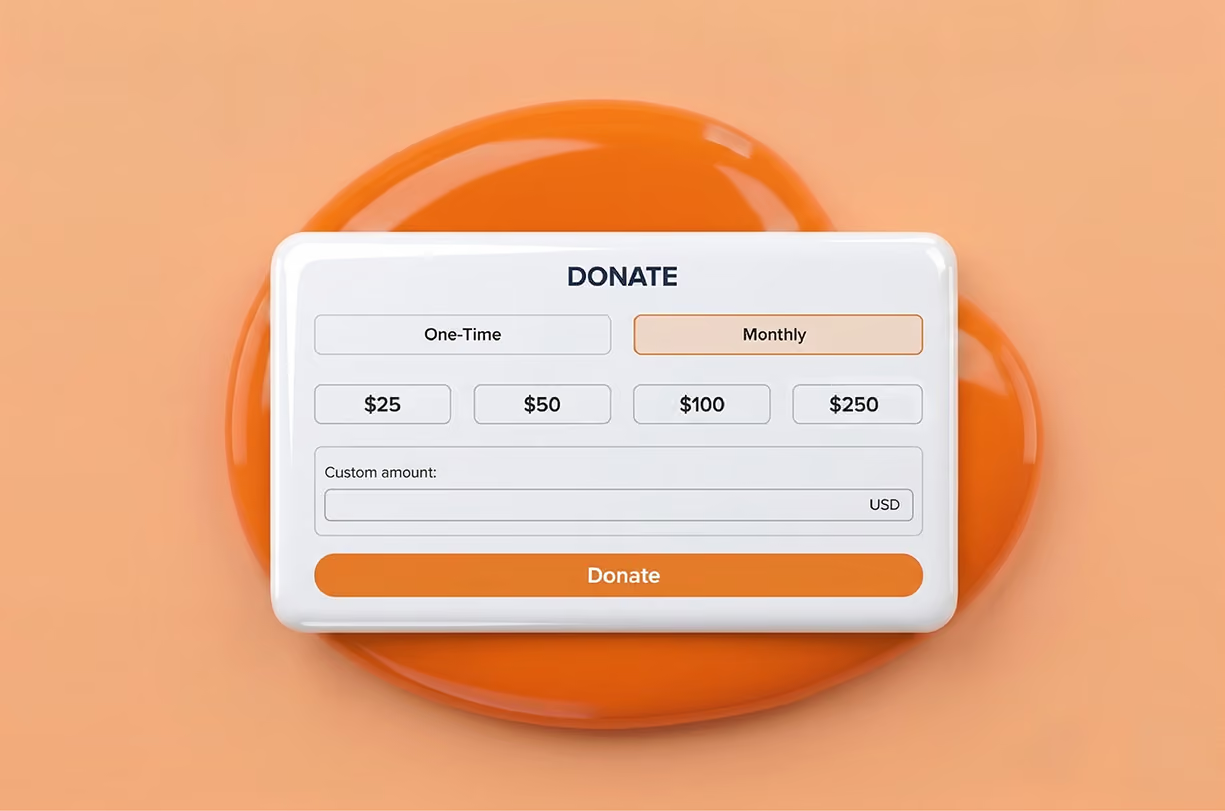
When looking for a nonprofit fundraising platform, search for one with customizable donation pages, recurring giving, mobile optimization, automatic tax receipts and low or no platform fees. Ideally, event ticketing and peer-to-peer fundraising support are also part of the package, even if an organization isn't planning to use them right away. A diverse range of integrated services will allow for seamless growth.
Level your fundraising foundation with Give Lively
Give Lively has everything needed for the early stages of an organization’s life and will scale with it as it develops. The fully rounded fundraising platform includes campaign pages, event ticketing and peer-to-peer fundraising, all with no platform, subscription or hidden fees. This allows more of what a new nonprofit raises to go directly toward its mission, all the more important for young organizations with limited resources.
Learn more about our free fundraising platform for nonprofits today. Ready to see how Give Lively can supercharge a nonprofit’s fundraising efforts? Sign up for a demo.
%201.svg)