Big-money fundraising ideas to dramatically increase donations

.svg)
.svg)
.svg)
.svg)

Lists of fundraising ideas are common, but most share the same flaw: they treat a bake sale and a capital campaign as equivalent options. The truth, however, is that some ideas raise only a little money, while others generate significant revenue that can influence a nonprofit’s priorities.
As you build or update a fundraising strategy, review this guide to six big-money fundraising ideas. These are the kinds of undertakings capable of producing generous returns that compound over time and deepening relationships with high-capacity donors.
6 big-money fundraising ideas to effectively boost revenue
From major gifts programs and corporate matching to capital campaigns and peer-to-peer fundraising, nonprofits have options for scaling revenue. Learn more about our top six big-money fundraising ideas:
1. Build a major gifts program
In the past, a majority of nonprofits expected about 80% of their total donation revenue to come from just 20% of their donor base. This reliance has grown. Researchers now estimate that about 90% of funding at nonprofits comes from 10% of donors. Given this, a formal effort to identify and steward high-impact donors is the most consequential program a nonprofit can develop.
The first step is to conduct prospect research, a process of analyzing giving history, wealth indicators and philanthropic affinity to identify supporters with the capacity and inclination to give at a major gift level. From there, it’s about intentional relationship-building, personalized communication and well-timed fundraising asks.
Organizations serious about scaling revenue typically bring on a major gifts officer (MGO) to manage this work. An MGO’s portfolio may be small, but the revenue potential tends to dwarf that of any single event or campaign.
2. Activate corporate matching gifts
Corporate matching is among the highest-return opportunities in nonprofit fundraising, but most organizations aren’t set up for it. Many employers – especially large corporations – match employee charitable donations, often at a 1:1 or 2:1 ratio, but an estimated $4 to $7 billion in matching funds goes unclaimed every year, almost entirely because donors don’t know the option exists.
Making match eligibility visible is a vital direct fix. Donation forms, confirmation emails, acknowledgment letters and year-end appeals are all opportunities to prompt donors to check whether their employer participates. Nonprofit fundraising platforms also may offer direct integrations with third-party service providers, like Double the Donation, that facilitate this process.
84% of donors say they’re more likely to give when a match is available. That makes match promotion a donor acquisition and retention tool, not just a revenue multiplier.
3. Launch a peer-to-peer fundraising campaign
Peer-to-peer fundraising works by turning existing supporters into fundraisers. Participants create an individual campaign page and promote it to their own network, leveraging personal trust to reach people who may have no prior relationship with the organization. Revenue grows directly with engagement, as the bigger and more motivated the peer-to-peer supporter base, the more a campaign can raise.
Peer-to-peer is an important scaling strategy as well by virtue of its impact on donor acquisition. Every campaign cycle brings in new donors from participants’ peer networks, growing the organization’s audience in a way direct and/or paid acquisition can’t replicate.
Dedicated peer-to-peer platform software handles page creation, donation processing and leaderboard tracking. For organizations ready to embrace that infrastructure, peer-to-peer is one of the few fundraising models where growth compounds with each new campaign.
4. Develop a planned and legacy giving program
Planned giving sits atop the donor pyramid of underutilized revenue sources. These are donations made through estate planning vehicles like wills, charitable trusts or life insurance policies. They’re often larger than anything donors give during their lifetimes. Organizations that build these programs today are positioned to receive some of the most generous gifts they may ever see.
One underappreciated aspect of planned giving is how to identify prospects. They don’t have to be major donors; small recurring donors – people giving $10 or $25 a month – may have the capacity to make a planned gift far larger than their annual giving suggests. Expanding the prospect pool beyond known major donors is a critical part of legacy fundraising.
Researchers have estimated that by 2048 Gen X will inherit $39 trillion and millennials will inherit $46 trillion. Nonprofits with an established planned giving program are positioned to capture a meaningful share of this historic transfer of wealth. Consider preparing a dedicated page, clear gift options and an outreach plan.
5. Run a capital campaign
A capital campaign is a focused, time-bound initiative to raise a predetermined amount of money for a specific purpose, such as a new facility, a major program expansion or an endowment.
These campaigns typically secure much of the total fundraising goal from major donors during a private phase before going public. As a result, the groundwork, prospect identification, relationship-building and a feasibility assessment are usually in place before the first public announcement.
Challenge grants work particularly well as part of a capital campaign. A grant-making organization pledges funds contingent on the nonprofit reaching a milestone first, creating urgency and setting a concrete rallying point. The donor relationships built during a well-run campaign tend to deepen in ways that fuel revenue long after it closes.
6. Build a recurring giving program
Recurring giving is the compounding interest of nonprofit revenue. A donor who commits to $50 a month gives $600 a year and, if well stewarded, may give for years or decades. Unlike one-time campaigns, recurring giving programs generate predictable revenue without the cost of reacquiring the same donor every cycle.
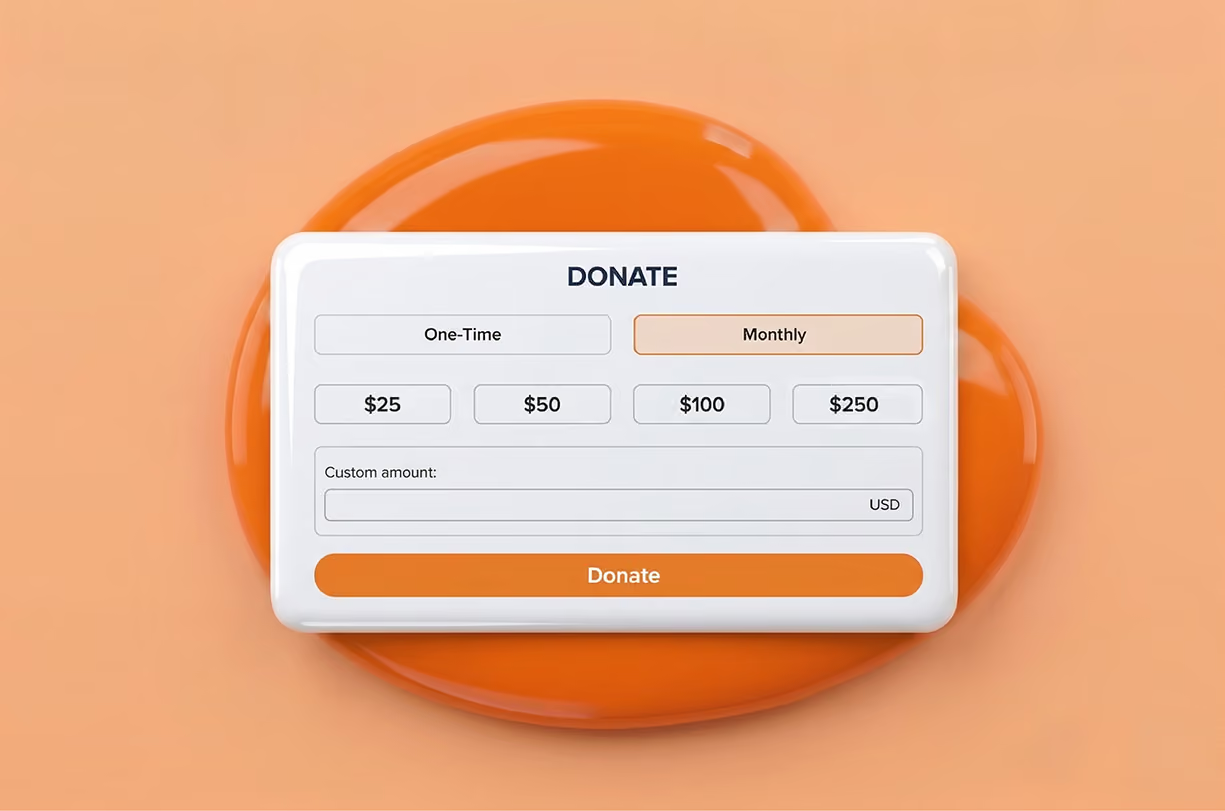
The infrastructure requirement is modest. Most modern donation platforms support recurring giving, such as monthly payments, with no or minimal setup. Making recurring giving the default option on donation forms, rather than a secondary opt-in, meaningfully increases adoption rates.
Pledge drives offer a related approach. Multi-payment commitments let donors give more over time than they can up front in a single gift, raising the total size of each commitment. Recurring donors are also far more likely to make a major gift or a planned gift.
Support your ideas with Give Lively’s free fundraising platform
Use Give Lively to drive or complement any of the ideas above. Powerful, practical and free for nonprofits, our nonprofit fundraising products can meet your needs without putting a dent in your budget. Our platform includes peer-to-peer fundraising, campaign pages, donation widgets, event ticketing, many integrations and several other features designed to support a nonprofit’s fundraising strategy.
Learn more about our fundraising platform’s features today.
%201.svg)