Peer-to-peer fundraising vs. crowdfunding: Selecting the right model for your organization

.svg)
.svg)
.svg)
.svg)
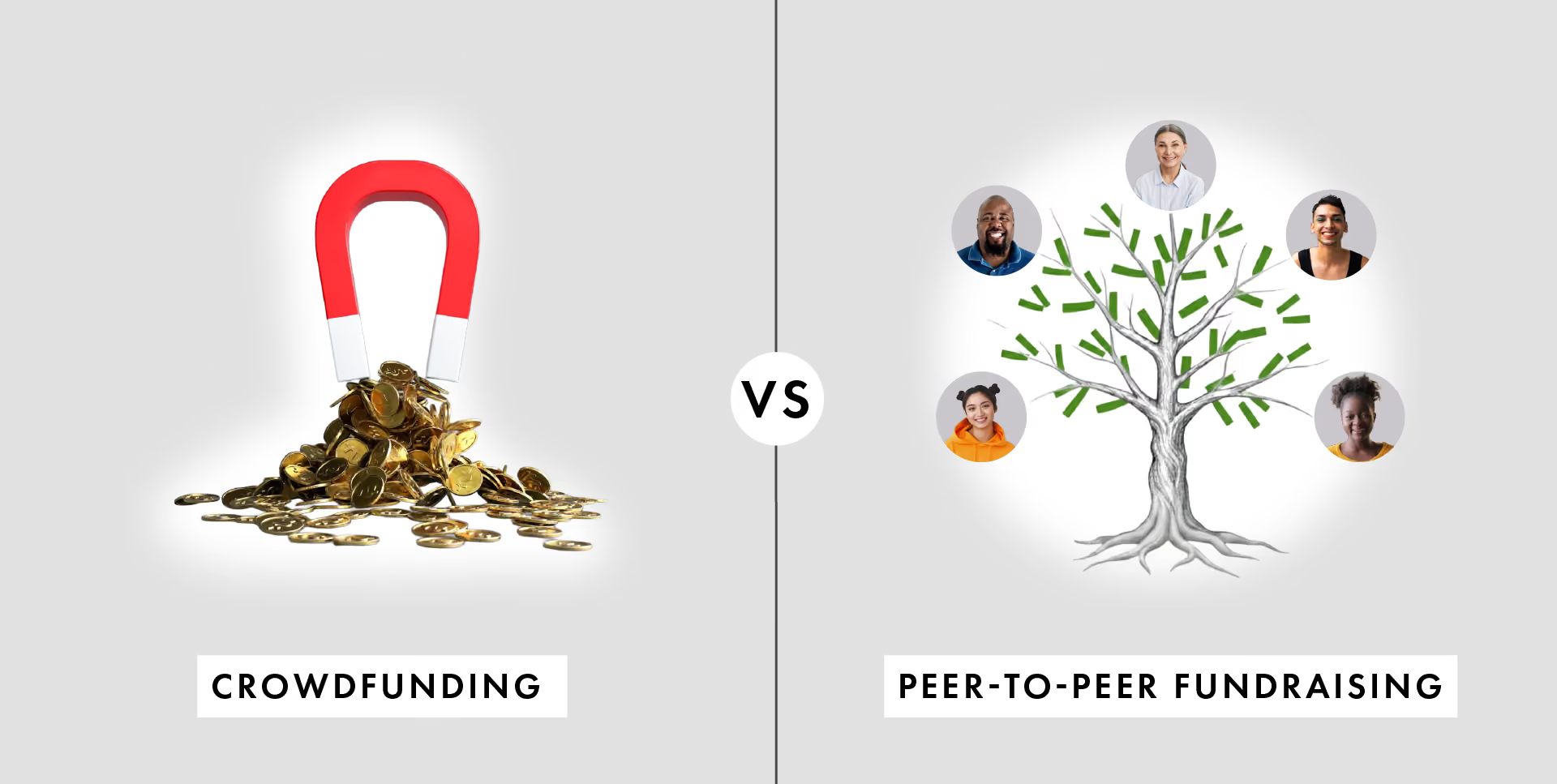
Crowdfunding and peer-to-peer (P2P) fundraising are two highly effective strategies for soliciting money online. While they may appear to be somewhat similar, they are fundamentally different in structure, effort and outcome. This comprehensive guide breaks down the mechanics of each method, delineates the key differences and provides practical advice on when to choose one over the other. It also explores the variations within P2P fundraising and discusses the importance of robust peer-to-peer fundraising platforms to your success.
Overview: Crowdfunding vs peer-to-peer fundraising
Crowdfunding relies on a nonprofit's direct marketing to drive donations to a single campaign page. Peer-to-peer fundraising (which includes team fundraising) empowers individual supporters to become advocates, reaching new donors through personal, trusted connections. Peer-to-peer fundraising is better suited to long-term growth and community engagement, while crowdfunding excels at meeting short-term, financial targets. Nonprofits should choose the strategy that best fits their immediate resource capacity and strategic objectives.
The fundamentals: Defining crowdfunding and peer-to-peer fundraising
Before diving into the nuances, let's establish a clear definition for each term in the context of nonprofit fundraising.
Crowdfunding: a centralized ask
Crowdfunding is perhaps the most widely recognized form of online fundraising.
Definition: Crowdfunding involves requesting donations from a broad audience, typically through a single, centralized webpage, to reach a specific financial goal by a set deadline.
How it works
- One page, one goal: Your organization creates a single campaign page detailing the project, the need and the funding goal. For example, "Raise $10,000 to purchase new classroom supplies before the school year begins."
- Donor journey: Supporters land on this central page and make a donation to your nonprofit.
- Marketing: The success of your campaign relies heavily on your ability to drive traffic to that single page through email marketing, social media, press releases, paid advertising etc. The messaging is usually high-intensity and focuses on the urgency of meeting the goal before the deadline.
- Typical use cases: Funding a specific product or project (e.g., a documentary), covering unexpected emergency costs (like disaster relief) or a short, intense appeal such as an end-of-year deadline.
Peer-to-peer fundraising: decentralized network effect
Definition: Peer-to-peer (P2P) fundraising enables your existing supporters to create their own personal fundraising pages and solicit donations from their family, friends, colleagues and other networks on behalf of your nonprofit.
How it works:
- Many pages, one cause: Your organization launches a central campaign page, but a lot of the fundraising occurs on dozens, hundreds or even thousands of individual, personalized pages created by volunteer "fundraisers."
- Donor journey: Donors give directly to these fundraisers’ pages and the money accrues to the core campaign. Donors give to support their friends and the cause.
- Marketing: Your efforts shift from asking for contributions to recruiting, training and motivating volunteer fundraisers, typically by empowering your most active supporters. The heavy lift of spreading the message yourself is shared with these passionate fundraising partners.
- Key advantage: It leverages trust. People are far more likely to donate when contacted by someone they know.
Peer-to-peer variations: individual vs. team fundraising
Peer-to-peer fundraising strategy has two top variations that cater to different types of campaigns.
Individual peer-to-peer fundraising
This is the classic model: A single supporter commits to fundraising for a nonprofit.
- Core driver: The individual's personal story and connection to the cause.
- Examples: A person running a marathon solicits pledges based on time and/or distance; a birthday campaign that asks for donations instead of gifts; an individual taking on a personal challenge for a cause.
Team fundraising
Team fundraising is an extension of the individual peer-to-peer model. Individual supporters organize into groups or "teams," each with a collective goal. Its structure allows nonprofits to manage scaled-up fundraising by engaging team leaders rather than managing many individual participants.
- Core driver and benefits: It introduces elements of friendly competition and social accountability, in addition to other psychological concepts leveraged in fundraising. Teams often compete against each other, motivating members to go the extra mile. It is an excellent way to engage a board of directors, corporate partners (who often rally internal teams) or larger community groups.
- Examples: A corporate walk-a-thon where companies form teams; a high school reunion where each home room forms a fundraising team.
Essential differences between crowdfunding and peer-to-peer fundraising
Choosing between these two strategies can be a hurdle. The direction you take hinges entirely on your organization’s resources, goals and existing relationship with your donor base.
Key differences
- Structure: Crowdfunding is centralized (one campaign page), while P2P fundraising is decentralized (many fundraisers’ pages).
- Goal: Crowdfunding usually has a specific deadline and financial target; P2P fundraising is often open-ended.
- Audience: Crowdfunding often targets a broad, public audience; P2P fundraising initially leverages supporters' personal networks, though it is also open to all.
- Best practices: By targeting a broad public audience, crowdfunding can be ideal for one-time projects (for example, funding a product/project or disaster relief) and the campaign description should reflect urgency and impact. The personalized nature of peer-to-peer fundraising is better for building community, event-based fundraising (e.g., marathons) and annual campaigns. Find the right words for year-round messaging.
- Donor acquisition (also see directly below): For crowdfunding, donors are acquired directly; for peer-to-peer fundraising, new donors are acquired indirectly through fundraisers' networks.
- Nature of relationship: Crowdfunding fosters transactional relationships because fundraising efforts are focused on a specific time-bound project. Peer-to-peer fundraising can build lasting relationships centered on supporters' involvement.
The value of new donor acquisition
One of the most compelling differences lies in donor acquisition.
- Crowdfunding may bring in new donors, but the relationship starts with the organization – a fresh connection – and needs to be nurtured from scratch.
- Peer-to-peer fundraising brings in donors who are “warmed up.” They already trust the fundraisers who asked them to give and they are likely cause aligned. Research consistently shows that donors acquired through peer-to-peer fundraising have a higher lifetime value because their first interaction with a nonprofit was through an honored social connection. This “network effect” makes peer-to-peer fundraising a key strategy for sustainable growth.
When to choose which strategy
Use this guide to assess your current needs and select the right tool for the job:
Choose crowdfunding if…
- You need donations fast for a specific project: If a pipe bursts and you need $20,000 for repairs this month, crowdfunding’s urgency makes it your best bet. It is an excellent tool for focused, time-sensitive fundraising.
- You have a limited or undefined supporter base: If your nonprofit is new or does not yet have an active list of willing volunteers, it may be harder to run a successful peer-to-peer campaign. Crowdfunding allows you to focus all available energy on broadcasting a message.
- The campaign is tangible and emotional: Crowdfunding performs best when the impact is immediately clear (for example, a photo of a struggling animal shelter, a video of a student who needs a scholarship). The emotion of the story drives spontaneous donations.
- You are an individual or small group: While peer-to-peer fundraising platforms exist for individuals (like Facebook Fundraisers), the usual crowdfunding structure is inherently simpler to manage for a team of one or two not equipped to activate a cohort of volunteers.
Choose peer-to-peer fundraising (including team fundraising) if…
- Your goal is community building and engagement: Peer-to-peer fundraising can double as volunteer recruitment and retention. It deepens the engagement of your most loyal supporters, turning passive donors into active advocates.
- You are planning an event (physical or virtual): Peer-to-peer fundraising is the engine of events like charity runs, walks and cycles; virtual gaming streams; or "shave-your-head" challenges. The event serves as the mechanism for direct fundraising requests.
- You want to acquire new donors and expand your reach: Peer-to-peer fundraising allows your organization to tap into networks you might not reach on your own. It is one of the best ways to rapidly expand your donor database with high-potential leads.
- You have the staff capacity for stewardship: Peer-to-peer fundraising requires staff for recruitment, training, resource development (toolkits, templates) and personalized encouragement to volunteers. If you have the personnel to manage a volunteer fundraiser corps, peer-to-peer fundraising can yield greater, more sustainable results. See how MEDLIFE motivated 6,500+ fundraisers.
The role of peer-to-peer fundraising platforms
Peer-to-peer fundraising ecosystems, especially team fundraising, tend to rely on specialized technology that processes payment and automates the most complex parts of the process. A robust peer-to-peer Fundraising platform provides:
- Easy fundraiser onboarding: A seamless process for supporters to sign up and launch their personal fundraising pages in minutes.
- Customization: Templates that allow fundraisers to personalize their pages with photos, videos and personal stories, all while maintaining your nonprofit's branding and legal compliance. Read how walk-a-thon participants supported the Sophia Ruggieri Memorial Foundation with their own peer-to-peer and team fundraising pages.
- Gamification and leaderboards: A leaderboard displays fundraising real-time progress, highlights top teams and individuals, and fosters competitive spirit.
- Integrations: Easy data syncs with existing CRMs/donor databases (like Salesforce) to automatically track and attribute donor gifts, ensuring all new contact data is captured correctly.
- Mobile optimization: Since peer-to-peer fundraising often happens via text or social media, the platform must function flawlessly on mobile devices.
Choosing the right technology partner is foundational to a successful peer-to-peer fundraising program. Look for platforms with clear fee structures, robust reporting capabilities and excellent customer support tailored to the unique needs of managing your volunteer fundraisers. Here’s a helpful chart that compares fees and capabilities of several top fundraising platforms.
Strategic alignment is key
Crowdfunding and peer-to-peer fundraising are not incompatible or mutually exclusive; they are complementary strategies that serve different strategic objectives.
As a nonprofit professional, your decisions should always align with your organizational goals:
- Need an immediate influx of cash for a specific, urgent need? Stick to the centralized, high-intensity marketing of crowdfunding.
- Looking to build long-term relationships, expand your community, leverage the power of events and acquire highly qualified new donors? Invest in the recruitment, training and technology necessary for peer-to-peer fundraising, embracing the immense potential of individual and team-based campaigns.
The digital landscape offers many types of fundraising opportunities. By choosing the strategy that best fits your needs, you can achieve your mission and empower your community to raise funds on your behalf.
%201.svg)