How software integrations power nonprofit efficiency

.svg)
.svg)
.svg)
.svg)
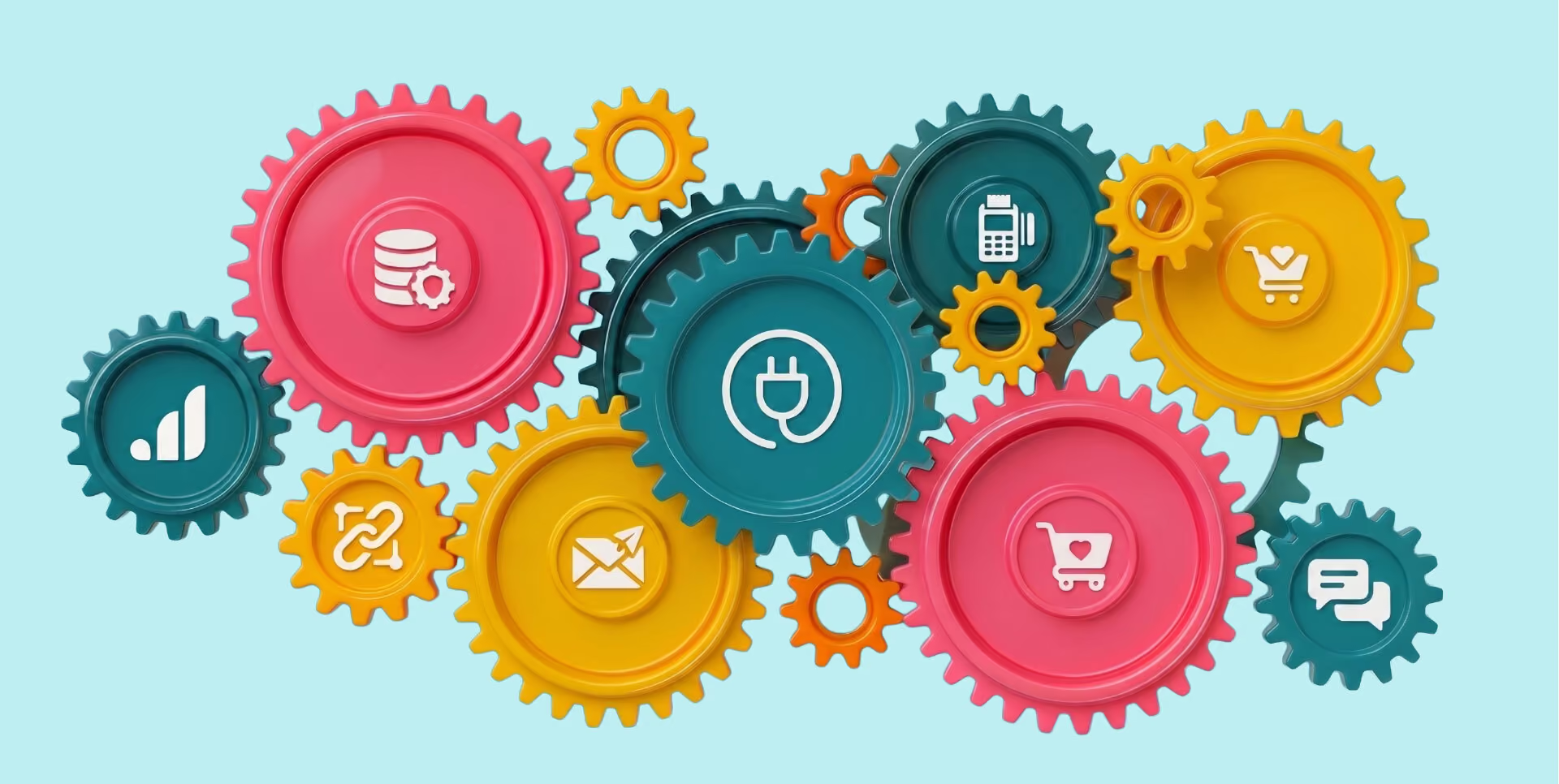
When a nonprofit is getting started, its fundraising tech setup is pretty straightforward: a donation form, an email platform and a spreadsheet with donation data. As the organization grows, however, so does the stack of software it relies on.
What happens next – how the nonprofit manages its growing volume of data across assorted platforms – is critical and influences the nonprofit’s success trajectory. One path leads to headaches. Data gets scattered across siloes. Staff has to copy things from one system to another by hand. Mistakes creep in and multiply. Decisions get made based on incomplete information.
Another path embraces application integrations for nonprofits that are designed to deal with the challenges outlined above. They are ready-made solutions for organizations trying to do a lot with a little.
What is an integration?
Simply put, a software integration connects tech tools so they can share automatically. Instead of a human toggling between systems to update or re-enter data, everything syncs behind the scenes. The result is tech applications that actually work together, not a collection of tools that operate in their own distinct worlds.
The practical upside of integrations is this: less manual work, fewer errors and more time for what actually moves a nonprofit’s mission forward.
What are the most common types of integrations?
There are a few ways integrations can work. While the approaches may differ, the goal is the same: to get tools functioning as a team.
- Custom API integration – An API (Application Programming Interface) is a built-in connection point that lets two software products pass information back and forth.
- Native integration – A native integration is where one application is custom-built to operate in tandem with a particular platform and naturally plugs into its ecosystem.
- Middleman tools – These act as a bridge between apps that wouldn't otherwise connect. One of the most common is Zapier.
Why do software integrations matter?
Integrations are valuable for all organizations, but especially important for nonprofits, where budgets can be tight, every hour of staff time counts and financial accountability is a core concern.
Data confidence
The biggest win from strong application integration is confidence in one reliable source of truth. When systems are connected, everyone on a team sees the same data – no more out-of-sync spreadsheets, no more confusion about which version is the most current.
For donor management, this matters a lot. An incomplete giving history can mean accidentally contacting a donor twice, missing a major gift conversation or losing touch with someone who's been giving for years.
Shared responsibility
Application integrations for nonprofits also distribute responsibility for data entry, which is a better practice than relying on one person to do it. Different people take charge of different inputs, but everything ends up in one place. That improves record accuracy and reduces stress on whoever used to be in charge of maintaining it.
Boosted team performance
Connected systems make routine work less fretful. When a fundraising platform and a customer relationship management tool (CRM) are in sync, staff can send more personalized outreach and follow up faster.
Streamlined administration
Nonprofits with small teams and effective integration-driven automations spend less time on administrative tasks. This results in amplified productivity. That's better for donors, better for the team and better for the mission.
What integrations does Give Lively offer?
Give Lively is a tech company that builds easy-to-use fundraising solutions that are intuitive and free for nonprofits. That same spirit guides our integrations: they're designed to be powerful without adding cost or complexity. In fact, we don’t charge anything for them, even our native Salesforce integration.
Give Lively integrations fall into two main buckets: fundraising and data tools, and payment processing.
Fundraising and data integrations
Salesforce for nonprofits
Give Lively for Salesforce is our flagship integration, given Salesforce’s consequential role in the nonprofit technology space. Salesforce’s platform for nonprofits is already a widely adopted CRM and our direct Give Lively for Salesforce integration is custom built to work with the Salesforce Nonprofit Success Pack (NPSP), automatically pushing Give Lively data into Salesforce every hour.
Donor information, donation details, campaign data, event records, peer-to-peer fundraisers – it all syncs without anyone lifting a finger. The integration can be found on Salesforce's AppExchange as a five-star-rated native app, is free to install and use, and comes with access to dedicated Give Lively integration specialists who can help with setup and troubleshooting at no extra charge.
Zapier
Zapier significantly extends Give Lively's reach. Through Zapier, nonprofits can connect Give Lively to more than 8,000 other apps using automated workflows called "Zaps" – no coding needed. This is fundraising automation at its best. We also have a library of ready-made Zap templates for popular tools like Mailchimp, Google, HubSpot and Little Green Light. Zapier offers a limited free plan but is otherwise a paid tool, while Give Lively's side of the integration is always free.
Double the Donation
Double the Donation facilitates and manages employer gift matching, a funding source left on the table by too many nonprofits because the process is complicated. This Double the Donation integration helps donors figure out if their employer will match their gift and makes it easy to complete, bringing in extra revenue without any additional effort from the nonprofit. Double the Donation charges for its services, but the integration with Give is free.
Other platforms
For nonprofit teams seeking to move data into a system beyond these direct integrations, Give Lively supports data exports as CSV files, which can be dropped into pretty much any CRM.
Payment processing integrations
Give Lively supports a wide range of payment processors and payment options. This matters more than it might seem; the easier it is for donors to complete a payment and the lower the third-party fees on the gift, the less likely donors are to abandon the payment. Meeting donors where they are and minimizing the cost of all transactions are real advantages.
Payment processors
- Stripe is currently the backbone of Give Lively's payment processing, handling donation intake and disbursement across all of our products with transparent fees and support for major payment methods.
- Shift4, an optional payment processor integration, adds another processor for even more flexibility.
- PayPal, a familiar and trusted way to give, is a second optional payment processor integration, much appreciated by donors who prefer to keep their card details off other websites.
Third-party payment processors charge small fees for every transaction. Importantly, there is a discounted base rate for qualified nonprofits. Registration is required with Stripe and PayPal, while Shift4 rates are automatically discounted through Give Lively.
Digital wallets
- For mobile donors, Apple Pay and Google Pay are two automatic integrations that make it possible to complete a donation in a single tap – no typing out card numbers, no friction. They lower the barrier to giving through the kind of seamless experience younger donors are accustomed to.
- Venmo is an added piece of the PayPal integration. As an app frequently used to split dinner bills and pay friends back, it can also be employed to support a cause.
Donor-advised funds
DAFpay, our latest optional payment integration, opens the door to donor-advised fund gifts. A donor-advised fund (DAF) is a charitable giving account to which donors contribute funds and receive an immediate tax deduction. Donors can then recommend grants from the DAF giving account to nonprofits in smaller amounts of their desire and over as much time as they like.
At present, DAFs are one of the fastest-growing ways people give charitably – there are hundreds of billions of dollars sitting in DAF accounts – but historically, nonprofits have had to manage DAF grants through phone calls, paper checks or clunky portals. DAFpay brings that process online, making it as simple as any other donation.
How are Give Lively's integrations critical to nonprofit efficiency?
Here's a picture of what nonprofit life can sometimes be like without integrations:
A donor gives online. Someone on staff downloads a report, manually enters the donor and donation details into a CRM, updates an email list and then tries to figure out if their employer offers a matching program. Every step takes time, introduces the chance for error and pulls attention away from work that actually needs a human touch.
With Give Lively's integrations running, that whole chain of events happens on its own. The donation details are synced to Salesforce every hour. A Zapier workflow could add the donor to the right Mailchimp segment. Double the Donation could flag a matching opportunity in real time. And whether the donor paid with Apple Pay, Venmo or a DAF grant, it all flows through cleanly – no manual reconciliation needed at the end of the day. That's fundraising automation doing exactly what it should: handling the back-end work so staff can focus on building real relationships.
For nonprofits that feel like they must choose between spending money on technology and spending it on their mission, Give Lively's free integrations are a game changer. Donors have a better experience, staff are less bogged down and the organization can punch well above its weight. That's what good application integrations for nonprofits actually do: they work quietly and efficiently in the background so the people and the mission can take center stage.
%201.svg)